
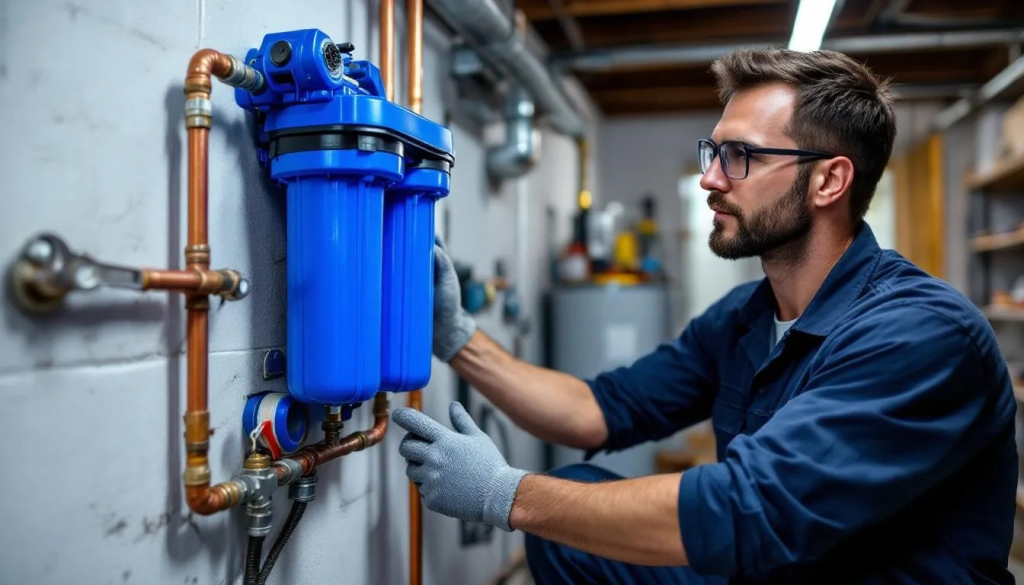
For many Jersey City homeowners, installing a whole-house filtration system feels like the ultimate solution. Clean water at every tap. Protection for appliances. Peace of mind for the entire family.
So when families still notice metallic taste, staining, or even detectable lead after installing a whole-house system, the reaction is often shock.
“If we filtered the entire house, how is this still happening?”
The answer usually lies in understanding what whole-house systems actually do and what they don’t.
Whole-House Filters Don’t Remove Everything
Most whole-house filtration systems are designed to address:
- Sediment
- Chlorine
- Odor
- Basic taste issues
Many use activated carbon or sediment pre-filters. While effective for improving water clarity and smell, these systems are not automatically certified for heavy metal removal.
According to the U.S. Environmental Protection Agency (EPA), contaminants like lead typically enter drinking water through corrosion of plumbing materials not from the treatment plant itself (https://www.epa.gov/ground-water-and-drinking-water/basic-information-about-lead-drinking-water).
If corrosion is occurring inside internal pipes, a basic whole-house filter may not be equipped to remove dissolved metals.
Lead Requires Specific Technology
Lead reduction requires filters certified under specific NSF/ANSI standards.
Many whole-house systems:
- Are not certified for lead removal
- Focus primarily on chlorine and sediment
- Do not include reverse osmosis
- Do not treat hot water lines differently
If a system wasn’t selected based on actual water test results, it may not be targeting the real issue.
Residents reviewing general local water conditions may assume the municipal supply is the source. But in Jersey City, building-specific plumbing materials often determine what comes out of the tap.
Corrosion Can Happen After the Filter
Even when a whole-house filter removes contaminants at the point of entry, water still travels through:
- Internal branch lines
- Vertical risers in multi-unit buildings
- Water heaters
- Brass valves and fixtures
If those downstream components contain aging materials, corrosion can occur after filtration.
That means filtered water entering the home may pick up metals before reaching faucets.
This is especially common in older Jersey City locations with legacy plumbing.
Professional water testing services can sample both pre-filter and post-filter water to identify where contamination is occurring.
Hot Water Isn’t Always Treated the Same Way
Some whole-house systems treat only cold water lines. If your hot water heater connects after filtration but corrosion occurs inside the tank, metal levels can rise in hot water samples.
Hot water dissolves metals more readily, which can explain why families notice issues primarily during showers or when using warm water.
Educational insights into how corrosion develops in mixed-age plumbing systems are available in the company’s blog.
Common questions about filtration effectiveness are also covered in the FAQ section.
Maintenance Is Frequently Overlooked
Whole-house filters require regular maintenance.
If cartridges are not replaced:
- Performance declines
- Contaminants can bypass saturated media
- Sediment can accumulate
- Flow restriction increases
Many families install systems but forget scheduled servicing.
Without periodic testing, there’s no confirmation that the system is still functioning as intended.
If you’re unsure whether your system is working properly, the contact page provides a direct way to arrange evaluation.
Mixed-Era Plumbing in Jersey City Homes
Jersey City’s housing stock often includes:
- Partial plumbing upgrades
- Layered renovations over decades
- Shared infrastructure in condos
- Older service lines connected to newer interiors
In these cases, filtration alone doesn’t solve infrastructure age.
A whole-house system treats incoming water but it doesn’t replace corroded risers or galvanized branch lines.
That’s why some families are surprised to see persistent issues even after investing in filtration.
Testing Before and After Installation Matters
The most common mistake is installing filtration without baseline testing.
Testing should occur:
- Before selecting a filtration system
- After installation
- Periodically thereafter
This confirms whether:
- The correct technology was chosen
- Metal levels are reduced
- Corrosion is occurring downstream
Without data, assumptions drive decisions.
Final Thoughts
Jersey City families are often surprised to discover that whole-house filtration isn’t a complete solution.
While these systems can significantly improve taste and sediment control, they don’t automatically eliminate metals or fix aging plumbing infrastructure.
Filtration treats water entering your home.
It does not replace pipes behind your walls.
In a city with mixed-age buildings and layered renovations, the only way to ensure your system is working is to test.
Because clean-looking water isn’t always fully treated water even with filtration in place.